


Japan Issued New Version of JIS A 4301:2025 Safety Code for Design and Manufacture of Home Elevators
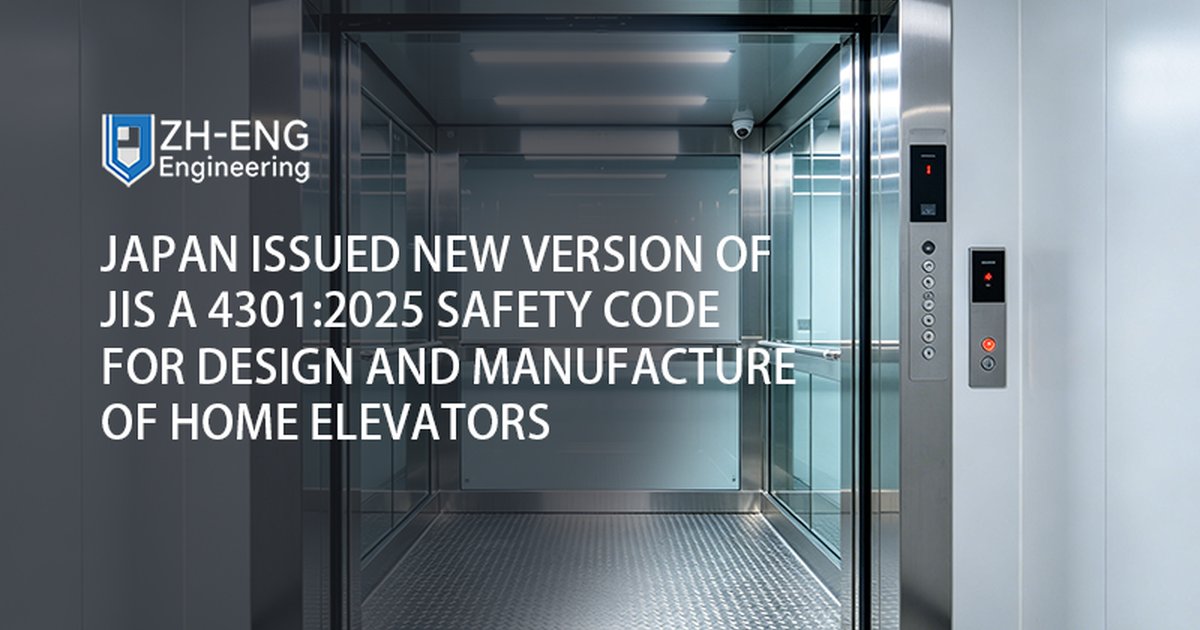
On April 12, 2025, the Japanese Industrial Standards Committee (JISC) officially issued the new version of Japanese Industrial Standard JIS A 4301:2025 Safety Code for Design and Manufacture of Home Elevators, replacing the old version of JIS A 4301:2016, which will officially take effect on October 12, 2025. It is the core safety guideline for the design, manufacture, installation and inspection of home elevators in Japan. The core upgrade contents of this standard revision include: First, expand the scope of application of the standard, covering traction type, screw type, hydraulic type and positive drive type home elevators used in private residences, and add special safety requirements for barrier-free home elevators and age-friendly home elevators. Second, upgrade the structural safety requirements of home elevators, refine the mandatory standards for mechanical strength, load calculation and safety factor of hoistways, cars, guide rails, suspension devices and supporting structures, and optimize the structural design guidelines for the use scenarios of home elevators with small hoistways and low floors. Third, strengthen the safety protection device requirements for home elevators, refine the mandatory technical standards for overspeed protection, overload protection, door interlock protection, fall protection and emergency rescue, and add special requirements for door system anti-pinch protection and child safety protection of home elevators. Fourth, add age-friendly and barrier-free design requirements for home elevators, and formulate special design guidelines for car size, control device, handrail setting, voice broadcast and emergency call according to the use needs of the elderly and disabled people. Fifth, upgrade the electrical safety requirements for home elevators, refine the mandatory standards for electrical systems, control devices, emergency power supplies and grounding protection, and add special requirements for electromagnetic compatibility, lightning protection and grounding, and short circuit protection of the electrical systems of home elevators. Sixth, standardize the installation and acceptance requirements for home elevators, clarify the standardized process of quality control, on-site inspection, load test and safety verification during the installation of home elevators, and improve the qualification criteria for delivery and use. Seventh, refine the maintenance and inspection requirements for home elevators, formulate standardized specifications for daily maintenance, regular inspection and safety assessment of home elevators, and clarify the maintenance items, frequency and inspection requirements. Eighth, add noise and vibration control requirements for home elevators, formulate limit standards and test methods for the operating noise and car vibration of home elevators, and improve the use comfort of home elevators. After its release, this standard has been adopted by the Ministry of Land, Infrastructure, Transport and Tourism of Japan as the mandatory technical basis for market access of home elevators in Japan, comprehensively improving the safety and quality level of home elevators in Japan.