


China Issued National Standard GB/T 24803.2-2025 Safety requirements for lifts—Part 2: Safety parameters meeting essential safety requirements
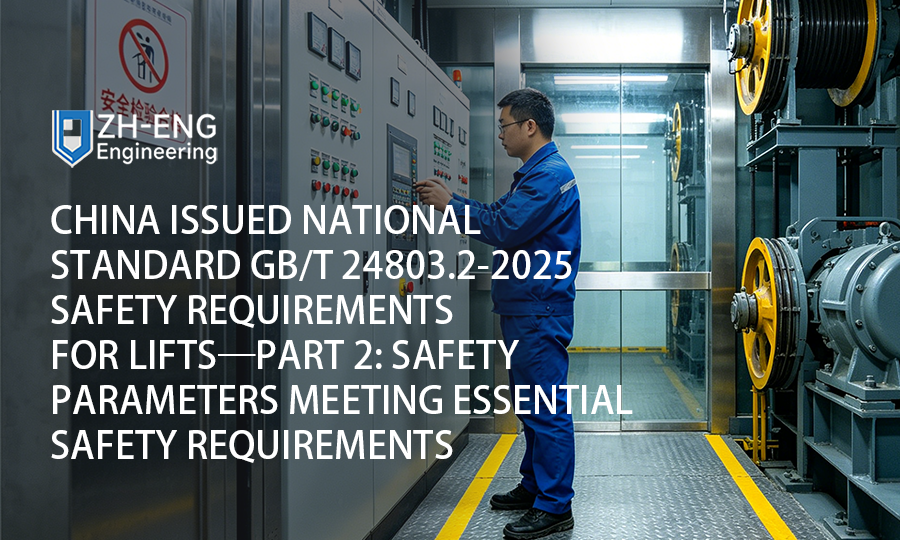
On August 1, 2025, the State Administration for Market Regulation and the Standardization Administration of China officially issued the national standard GB/T 24803.2-2025 Safety requirements for lifts—Part 2: Safety parameters meeting essential safety requirements, which will be officially implemented on February 1, 2026. It is modified and adopted the international standard ISO/TS 8100-21:2018, and is coordinated and unified with the core elevator safety standards such as GB/T 7588.1-2020. The core contents of this standard include: First, clarify the scope of application of the standard, covering traction, positive drive and hydraulic passenger elevators and freight elevators, applicable to the setting and verification of safety parameters in the whole process of elevator design, manufacture, installation, inspection and transformation. Second, establish an elevator safety parameter system, formulate a comprehensive safety parameter framework around three types of risks: personnel injury risk, equipment failure risk, and environmental impact risk, covering all dimensions of mechanical safety, electrical safety, functional safety, fire safety, seismic safety, and barrier-free safety. Third, refine the core safety parameter indicators, supplement a number of safety parameter indicators for core safety scenarios such as equipment accessibility, ground tripping risk, relative movement danger, locking device, lighting system, seismic response, overspeed protection, and overload protection, raise the landing lighting standard from 50 lx to 100 lx, optimize the parameter values such as hoistway enclosure height and step spacing, and achieve coordination and unification with the latest elevator safety standards. Fourth, standardize the design and verification requirements of safety parameters, clarify the calculation method, test process, verification guidelines and qualification criteria of elevator safety parameters, and provide a standardized basis for the setting of safety parameters in the elevator design and manufacturing process. Fifth, add safety parameter requirements for special scenarios, and formulate differentiated safety parameter adjustment guidelines and verification requirements for special use scenarios such as seismic zones, high temperature and high humidity, alpine, explosion-proof, and fire protection. Sixth, standardize the safety parameter requirements for the transformation of in-use elevators, and clarify the upgrading guidelines, verification process and qualification criteria of safety parameters for the upgrading and transformation of old elevators, providing a technical basis for the transformation of old elevators. Seventh, add the risk assessment requirements for safety parameters, formulate a risk-based setting and optimization method for elevator safety parameters, and clarify the whole process specification of risk identification, risk assessment and risk reduction. The release of this standard has improved China's elevator safety standard system, provided a more scientific and systematic safety parameter basis for the safety design, manufacture and inspection of elevator products, and comprehensively improved the safety level of elevator products in China.