


China Issued GB/T 24477-2025 Standard for Barrier-free Design of Elevators, Implemented on September 1, 2025
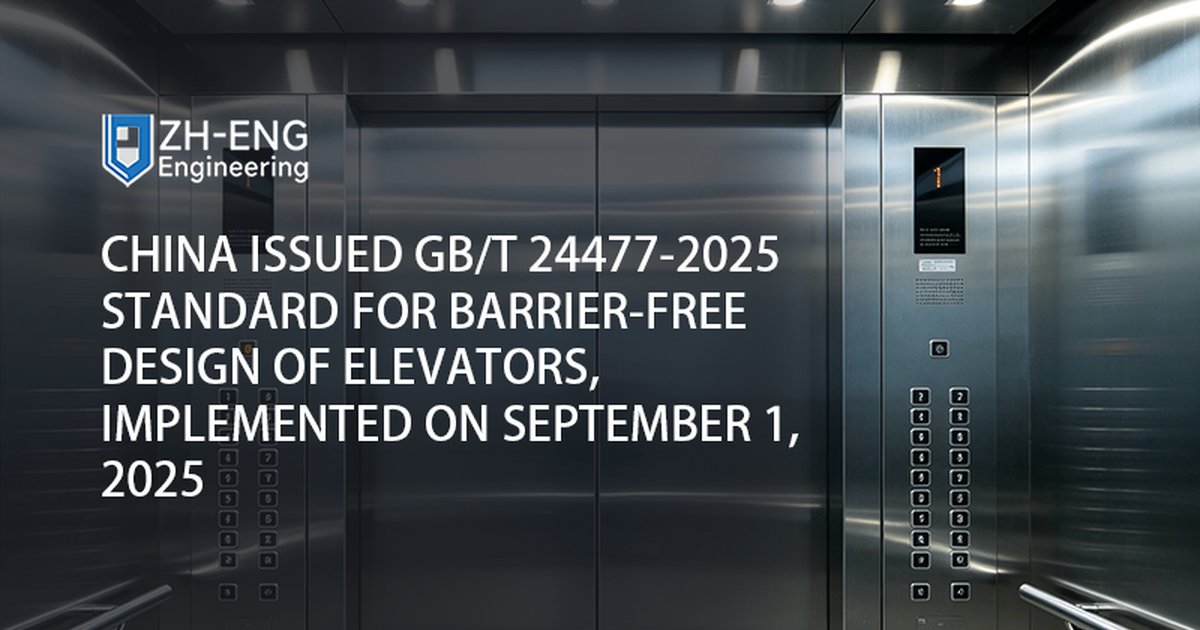
On February 28, 2025, the State Administration for Market Regulation and the Standardization Administration of China jointly issued Announcement No. 2 of National Standards in 2025, approving and issuing the national recommended standard GB/T 24477-2025 Additional Requirements for Lifts Suitable for Persons with Disabilities. The standard is under the jurisdiction of the National Technical Committee for Elevators of China, modified and adopted from the international standard ISO 8100-7:2024 Lifts for the transport of persons and goods — Part 7: Accessibility of lifts including use by persons with disabilities, completely replacing the old version of GB/T 24477-2009, and officially implemented on September 1, 2025. This standard makes comprehensive specifications for the whole life cycle technical requirements of barrier-free elevators. The core contents include: First, it clarifies the scope of application of the standard, which is applicable to passenger elevators installed in buildings and used by persons with disabilities (including visually impaired, hearing impaired, physically impaired and cognitively impaired persons), covering new manufacturing elevators and barrier-free transformation scenarios of existing elevators; Second, it improves the barrier-free design requirements of the car, updates the design specifications of the car's internal size, installation height and layout of the operation panel, Braille signs, voice announcement system and emergency call device, and clarifies the relevant technical requirements of the wheelchair turning space, handrail installation and mirror setting; Third, it adds relevant technical requirements for the adaptation of visually and hearing impaired persons, improves the design standards of elevator sound and light prompts, floor signs and tactile guidance systems, and adds relevant technical specifications for elevator intelligent voice interaction and barrier-free remote control; Fourth, it revised the barrier-free design requirements of landing doors and elevator lobbies, clarified the relevant specifications of elevator lobby size, landing door entrance width, installation height and layout of call buttons, and floor signs, and improved the design standards of barrier-free elevator lobby areas; Fifth, it supplements the relevant requirements of elevator operation performance. For barrier-free use scenarios, it clarifies the control requirements of elevator acceleration and deceleration, leveling accuracy, door opening and closing time, and operating noise, and improves the comfort and safety of disabled people taking elevators; Sixth, it adds the technical specifications for barrier-free transformation of existing elevators, clarifies the transformation principles, technical requirements and acceptance standards for barrier-free upgrading of old elevators, and provides a standard basis for barrier-free transformation of elevators in existing buildings. The implementation of this standard has further improved China's standard system for barrier-free environment construction, promoted the standardized development of elevator barrier-free facilities, protected the travel rights and interests of special groups such as the disabled and the elderly, and at the same time achieved alignment with international barrier-free elevator standards, providing standard support for the international trade of China's elevator products.