


The European Union Issued EN 81-31:2024 Safety Standard for Accessible Goods-only Lifts, Implemented from October 2024
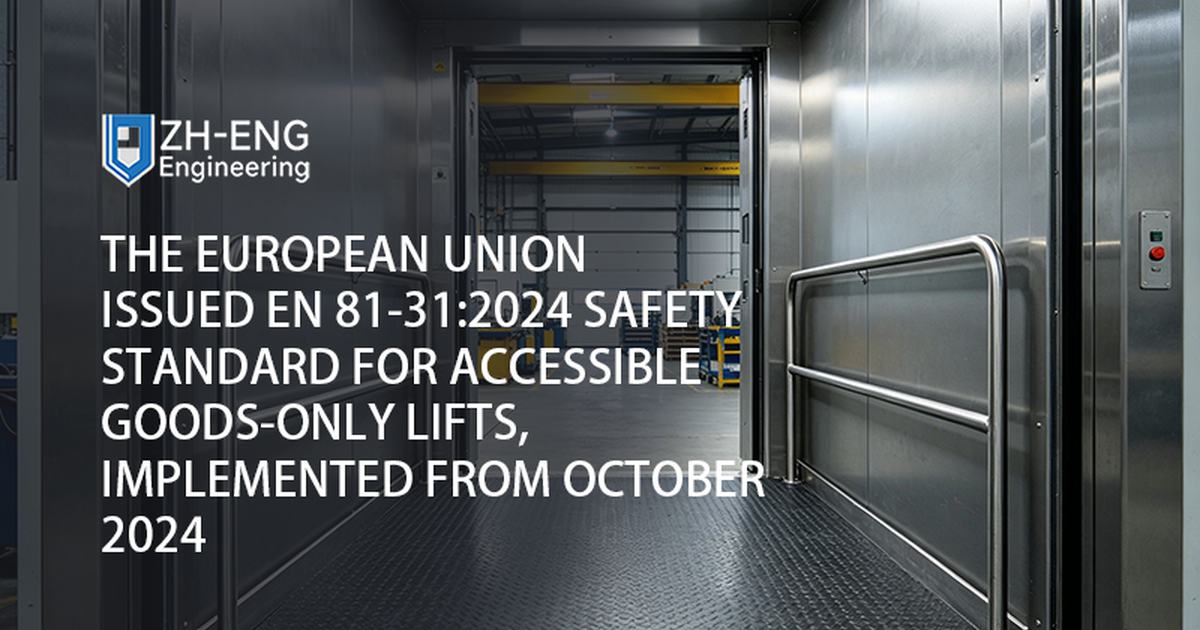
On March 12, 2024, the European Committee for Standardization (CEN) officially approved and issued the EN 81-31:2024 European standard, which was developed under the leadership of the CEN/TC 10 Technical Committee for Lifts, Escalators and Moving Walks. It is a special core specification for accessible goods-only lifts in the EU elevator safety standard system, and will serve as the core technical basis for CE certification of goods lift products in the EU market. This standard clearly defines the use scenario of accessible goods-only lifts, that is, goods-only lifts whose main design purpose is to transport goods, while allowing operators to enter the car with goods for loading and unloading operations. It is different from non-accessible goods-only lifts and passenger-cargo dual-purpose lifts, and fills the gap in the previous standards for this type of product. The core technical contents of the standard include: First, it clarifies the design safety requirements of car size, entrance width and protective fence. For loading and unloading operation scenarios, it improves the mechanical protection and electrical safety interlocking requirements of car doors and landing doors to prevent the risk of personnel falling and shearing; Second, it stipulates the design limits of the rated speed and rated load of the elevator, and clarifies the design and calculation specifications of the traction system, braking system and guide system of goods lifts with different load levels; Third, it improves the safety protection requirements for personnel entering the car with goods, adds relevant technical requirements for personnel presence detection in the car, overload protection, and anti-overturning protection, and clarifies the safety protection standards of the operation area; Fourth, it updates the technical specifications for elevator installation and acceptance, clarifies the installation process, on-site test items, acceptance judgment standards of accessible goods-only lifts, and improves the design and construction safety requirements of shafts, machine rooms and pits; Fifth, it supplements the relevant specifications for elevator maintenance and regular inspection, clarifies the maintenance cycle, inspection items and safety assessment requirements of this type of elevator, and provides a technical basis for the whole life cycle safety management of the elevator. The implementation of this standard has unified the safety technical specifications for accessible goods-only lifts in EU member states, eliminated technical barriers to trade in the region, and provided a unified standard guideline for the production, sales and installation of goods lift products in the EU market.