


Insulation Becomes a Factory-Controlled Performance Interface in MMC
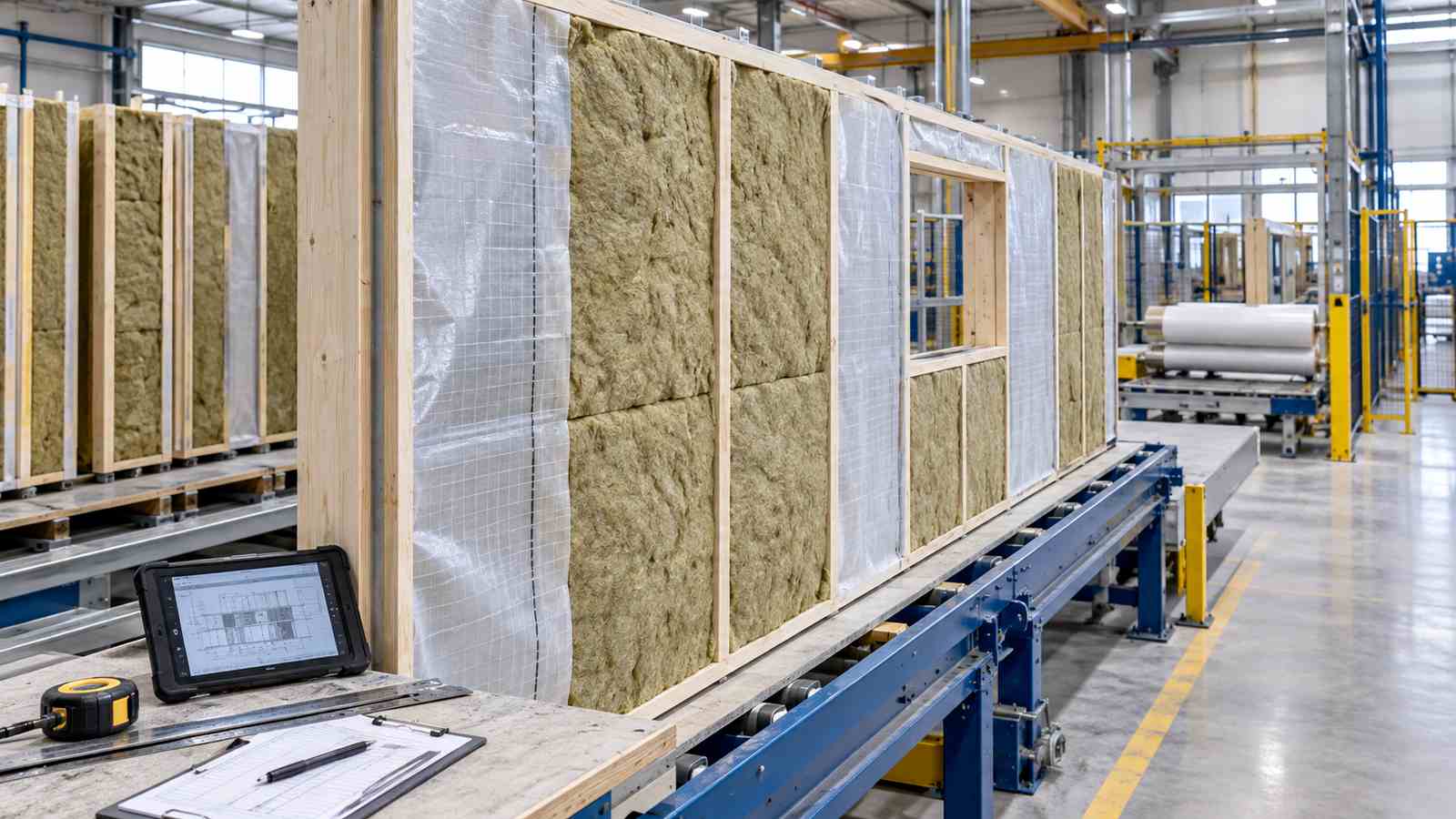
Insulation is becoming a controlled manufacturing interface rather than a material added late in an MMC project. An Offsite Hub technical article argues that factory integration can improve repeatability, thermal continuity and waste control. For buyers, performance still depends on the complete tested or calculated assembly, workmanship and junction details.
What the Source Highlights
The Offsite Hub article describes insulation as part of a fabric-first approach across volumetric modules, panelised systems, timber frames, steel frames, floor cassettes and non-structural pods. It links factory installation with more consistent placement, reduced gaps and closer alignment between design intent and the finished building.
The article identifies thermal performance, acoustic control, fire performance, space efficiency and airtightness as connected outcomes. It also notes that insulation specifications may support low U-values and heat-pump strategies, but only when the product and build-up are correctly selected and installed.
Why the Complete Assembly Matters
Thermal calculations depend on junctions
Nominal conductivity is only one input. Studs, rails, connectors, corners, module joints and penetrations can create repeating or linear thermal bridges. In England, the government's Approved Document L guidance provides the regulatory context for conservation of fuel and power, but each project must use the applicable national and local requirements.
Fire claims must match the installed system
Reaction-to-fire classification and fire-resistance performance are different questions. Buyers should check the substrate, cavity, membranes, fixings, penetrations and joint treatment used in the supporting evidence. The government's Approved Document B guidance is a useful regulatory reference for England; it does not replace project-specific fire engineering or approval.
ZH-ENG Analysis
Offsite production creates an opportunity to record insulation installation before panels or modules are closed. Photographic inspection, material batch traceability and measured junction checks can turn hidden work into auditable handover evidence. That value is lost if substitutions occur without recalculation or if site joints are treated as a separate package.
What International Buyers Should Specify
- Procure the full wall, roof or floor build-up rather than an insulation product in isolation.
- Request U-value calculations, thermal-bridge assumptions and condensation-risk analysis for the destination climate.
- Match acoustic and fire evidence to the proposed layers, fixings and joints.
- Define factory inspection points before cavities are closed.
- Include transport moisture protection and site-joint completion in the quality plan.
Buyers developing panelised or volumetric projects can review ZH-ENG modular building solutions and submit the climate, target performance, wall build-up and approval basis for configuration review.
Sources
Offsite Hub - The Vital Role of Insulation in MMC
https://www.offsitehub.co.uk/the-vital-role-of-insulation-in-mmc/