


ISO 8100-7:2024 International Standard for Elevator Accessibility Officially Released, Implemented from December 2024
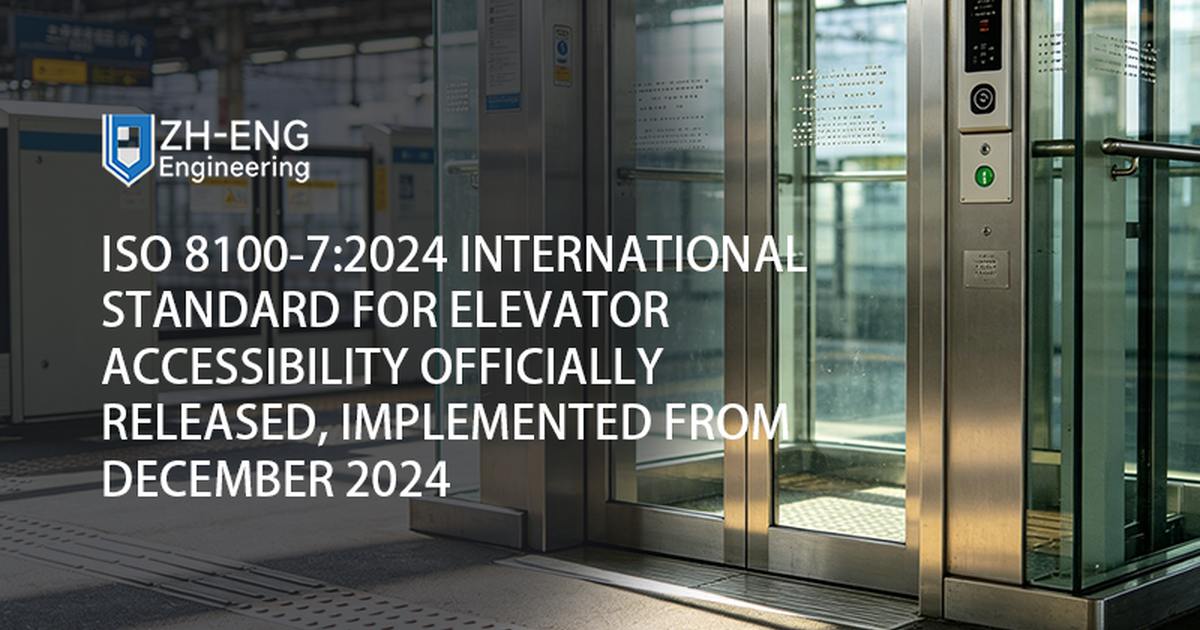
On June 28, 2024, the International Organization for Standardization (ISO) officially issued the ISO 8100-7:2024 international standard, which was developed under the leadership of the ISO/TC 178 Technical Committee for Lifts, Escalators and Moving Walks. It is the core international specification in the field of barrier-free elevator design in the world, and will be converted into national standards by most countries around the world as the core technical basis for market access of barrier-free elevator products. Compared with the 2018 version of the old regulation, the 2024 version of the standard released this time has made major technical updates. The core contents include: First, expand the scope of application of the standard, covering not only visually impaired and physically impaired personnel, but also newly added adaptation requirements for hearing impaired, cognitively impaired and elderly people with reduced mobility, realizing full coverage of special groups; Second, improve the core specifications for barrier-free design of the car, update the design standards for the minimum internal size of the car, wheelchair turning space, installation position and size of handrails, clarify the mandatory requirements for the installation height, key size and layout spacing of the operation panel, optimize the design specification of Braille signs, requiring that Braille signs must correspond to the keys one by one, and the installation position is clear and easy to touch; Third, add relevant technical requirements for intelligent interactive systems. For the voice interaction, gesture control and remote call functions of smart elevators, it clarifies the design specifications and test standards, requiring that the voice system must support multiple languages, with clear pronunciation and adjustable speed. At the same time, it improves the adaptation requirements of elevators and assistive devices (such as wheelchairs and guide canes); Fourth, revise the barrier-free design specifications of elevator lobbies and landing doors, clarify the design standards of the minimum passage width of elevator lobbies, installation height and layout of call buttons, and floor visual signs, and add relevant technical requirements for tactile guidance systems and sound and light prompt systems to ensure that visually and hearing impaired personnel can complete the elevator operation independently; Fifth, optimize the relevant requirements of elevator operation performance. For barrier-free use scenarios, it clarifies the control limits of elevator acceleration and deceleration, leveling accuracy, door opening and closing speed and residence time, and operating noise, improving the comfort and safety of special groups taking elevators; Sixth, add a technical guide for barrier-free transformation of existing elevators, clarify the transformation principles, technical paths and acceptance standards for barrier-free upgrading of old elevators, and provide a unified technical guideline for barrier-free transformation of elevators in existing buildings around the world. The issuance of this standard has unified the technical specifications of barrier-free elevators around the world, promoted the coordinated development of global barrier-free environment construction, and provided a unified standard basis for the international trade of global barrier-free elevator products.