


National Standard GB/T 43106-2026 Technical Specifications for Ultra-High-Speed Elevators Officially Released
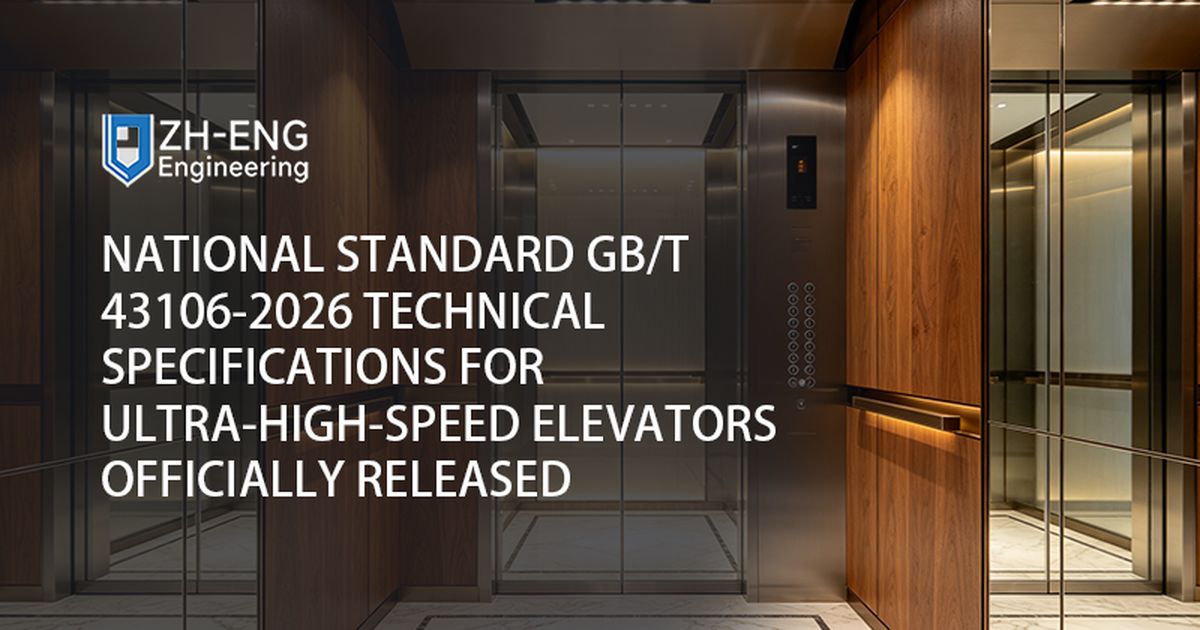
Compiled by the National Technical Committee for Elevator Standardization jointly with super high-rise building design institutes, this standard's core contents include:
first, aerodynamic performance specification, addressing wind resistance and noise issues during ultra-high-speed operation, stipulating technical requirements for streamlined car design, shaft ventilation optimization, air pressure regulation system, operating aerodynamic noise ≤65dB, shaft air pressure fluctuation ≤500Pa;
second, vibration comfort control, clarifying horizontal vibration acceleration ≤0.1g, vertical vibration acceleration ≤0.15g, operation stability level ≥ Grade A, equipped with active vibration reduction system, air spring, high-precision guide rail to ensure comfort during high-speed operation;
third, safety protection upgrade, ultra-high-speed elevators must be equipped with four-fold safety protection: bidirectional overspeed governor, multi-stage safety gear, redundant buffer, redundant emergency brake, safety component response time ≤0.02s;
fourth, drive system requirement, adopting permanent magnet synchronous direct drive, high-power frequency conversion, energy feedback system, drive efficiency ≥96%, standby energy consumption reduced by 60%;
fifth, monitoring and emergency, equipped with full-life cycle online monitoring, multi-dimensional fault early warning, emergency air leveling, dual-circuit independent power supply to ensure safety under extreme working conditions.
After implementation, China's ultra-high-speed elevator technology fully aligns with international top levels, providing authoritative Chinese standard basis for global super high-rise building elevator procurement.